
MVP as continuous learning — experiments over feature drops, and why direction plus signal interpretation matter more than docs.
NewAI Is Speeding Up Iteration — And Making PM Judgment More Critical Than Ever
When shipping gets cheap, iteration stops looking like versioned releases and more like a live experiment loop. The scarce work moves upstream: choosing what to validate, telling directional signal from noise, and reframing MVP as a minimum learning unit.
AI Is Speeding Up Iteration — And Making PM Judgment More Critical Than Ever
I. A Fundamental Question
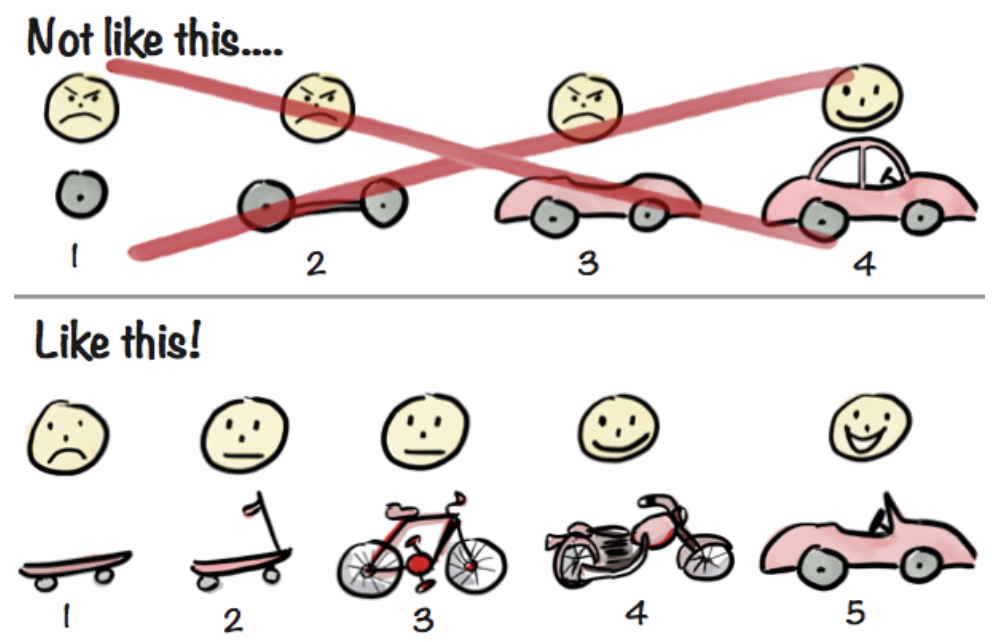
I recently revisited Henrik Kniberg’s Making Sense of MVP, and one idea stood out more clearly than before. He uses the analogy of “skateboard → bicycle → motorcycle → car” to explain MVP. At its core, it is not about “gradually improving a product,” but something more important: validating an assumption with the smallest possible cost as quickly as possible.
In traditional product development, this kind of “upgrade path” is often extremely expensive. When I first saw these diagrams, I often thought: from motorcycle to car, almost the entire codebase would be rewritten. From an engineering perspective, it feels almost impossible. So I used to treat this as an idealized development process.
The real problem is not whether you can build a more complete version, but that the further you go, the less flexibility you have to validate your assumptions.
II. AI Is Changing Not Efficiency, but the Iteration Model
What truly changed my perspective is AI. I clearly feel that the rhythm of product iteration is undergoing a structural shift.
Previously, an MVP cycle looked like this:
- Design → Development → Launch
- Instrumentation → Data collection
- Analysis → Iteration
A complete loop usually took weeks or even months.
But now:
- AI can quickly generate prototypes
- Assist or even replace parts of development
- Analyze user behavior in real time
- Automatically organize and categorize user feedback
What used to take weeks can now often be completed in hours.
This is not just about being “faster.” It is a fundamental change in the way products iterate. MVP is no longer a phase-based versioning process, but a continuously running system. Products are no longer released version by version—they are constantly being tested, adjusted, and tested again.
The dream of “motorcycle → car” is becoming achievable with AI.
III. Agile Is Becoming an Experimental System
This also reshapes how I understand Agile. On the surface, we are still doing iterative development, but the essence has changed.
Previously, a sprint was about delivering features. Now, a sprint is closer to running experiments.
The questions I focus on are no longer:
- Is this feature finished?
But instead:
- Has this hypothesis been validated?
- What does user feedback imply?
- What should we test next?
Development is no longer the accumulation of features, but the continuous optimization of experiments.
IV. The PM Role Is Shifting Upstream
In this shift, my understanding of the PM role has also changed.
Previously, PM work was mainly:
- Gathering requirements
- Writing PRDs
- Coordinating design and engineering
But these are becoming less central. The real core of PM work is increasingly two things:
1. Deciding what to validate
AI can help build things quickly, but it cannot tell us:
- Which direction is correct
- Which problem is worth solving
- Which hypothesis is worth testing
If these decisions are wrong, faster iteration only means faster waste.
2. Extracting signal from feedback
Today’s problem is no longer lack of data, but too much data: user behavior logs, clicks, text feedback, conversations—all continuously generated.
AI can help:
- Cluster feedback
- Summarize insights
- Perform sentiment analysis
But it cannot solve a key issue:
What is noise, and what is a directional signal?
For example:
- Is a user complaint an outlier or a trend?
- Is low feature usage a design issue, or does the need not exist at all?
These judgments ultimately require human interpretation. And increasingly, this ability is becoming the core value of a PM.
From a broader perspective, I now see product development as a continuous learning system:
- AI generates and executes
- Agile provides the iteration loop
- PM defines direction and interprets signals
A product is no longer a static collection of features, but a system that continuously interacts with users and adapts over time.
V. Personal Reflection
My conclusion is:
AI does not make PM less important—it makes PM more important.
Because when “building things” becomes cheap, what becomes scarce is:
- What to build
- Why we build it
- What we learn from the outcome
I now interpret MVP differently. It is no longer just the “Minimum Viable Product,” but rather:
Minimum Learning Unit
Product development is no longer a 0-to-1 construction process, but a continuous experimental loop. And in this loop, what matters most is not what you build, but:
Whether you made the right judgment.